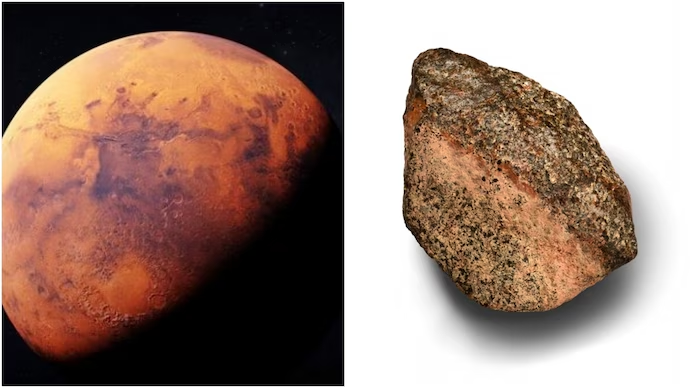

Martian meteorites are among the rarest and most fascinating rocks ever discovered on Earth. These mysterious space rocks originated on Mars and traveled millions of kilometers through space before eventually landing on our planet.
Scientists study them to understand the Red Planet’s history, including its ancient atmosphere, volcanic activity, and the possibility that Mars once supported microbial life.
Scientists Discover 4.1-Billion-Year-Old Martian Meteorite That Could Reveal Secrets of Ancient Mars
A mysterious pink-colored rock discovered in the Sahara Desert has turned out to be one of the oldest Martian meteorites ever found on Earth. Scientists say the extraordinary space rock could provide new clues about Mars’ ancient environment, including evidence of water that existed billions of years ago.
Named Teghaza 001, the meteorite was discovered in 2022 in Mali. After years of scientific investigation, researchers have determined that it formed more than 4.1 billion years ago, making it an extremely valuable discovery for planetary science.
The findings were published in the scientific journal Science and announced by NASA on October 29, 2026.
A Rock From Another Planet
Teghaza 001 weighs approximately 800 grams and has a distinctive rose-colored appearance. Although it may look like an ordinary rock, its mineral composition reveals a remarkable origin.
Scientists confirmed that the meteorite came from Mars by examining its chemical composition and oxygen isotopes, which act like fingerprints that help identify where rocks originated.
Researchers believe the rock was blasted off the Martian surface by a powerful asteroid impact. It traveled through space before eventually reaching Earth and being discovered in the Sahara Desert.
Evidence of Water on Ancient Mars
One of the most exciting aspects of this discovery is the evidence that water interacted with the rock billions of years ago.
Scientists discovered unusual minerals and tiny zircon crystals inside Teghaza 001. By studying these minerals, researchers were able to determine the meteorite’s age and identify signs of changes caused by water.
The findings suggest that ancient Mars may have had a much more active geological environment than the cold, dry planet we see today.
Scientists believe liquid water may have seeped into the Martian crust and interacted with rocks as they formed and cooled. This raises new questions about whether ancient Mars once had environmental conditions suitable for supporting microbial life.
However, researchers emphasize that evidence of water does not mean evidence of life. The discovery provides important clues about Mars’ past, but further research is necessary.
Scientists Call It a Rare Scientific Treasure
Teghaza 001 is particularly valuable because very few Martian meteorites have been discovered on Earth.
NASA estimates that approximately 435 meteorites identified on Earth originated from Mars. However, only a small number provide such an ancient record of the planet’s early crust.
Scientists have identified 13 possible locations on Mars that match the meteorite’s mineral composition and chemistry. These locations could help researchers determine where the rock originally formed.
The discovery may also help scientists identify promising areas for future Mars exploration missions.
Could This Discovery Help Scientists Find Life on Mars?
For decades, scientists have investigated whether Mars once had conditions capable of supporting life.
The discovery of Teghaza 001 provides additional evidence that water played an important role in shaping the planet’s early environment. Water is considered one of the essential ingredients for life as we know it.
Although the meteorite contains no confirmed evidence of ancient life, it offers scientists a rare opportunity to investigate the chemical and geological conditions that existed billions of years ago.
Future studies could reveal more about how Mars evolved from a potentially warmer, wetter world into the cold and largely dry planet it is today.
Conclusion
The discovery of Teghaza 001 demonstrates how an ordinary-looking rock can hold extraordinary secrets about the universe.
After spending billions of years preserving clues about Mars’ ancient history, this rare meteorite is now helping scientists investigate the planet’s early crust, volcanic activity, and interactions with water.
As researchers continue studying this remarkable specimen, it may reveal even more information about Mars and whether the Red Planet once had the right conditions for life.
Could Mars have supported life billions of years ago? Scientists are still searching for answers, and this ancient meteorite may bring them one step closer.
SEO Tags
Martian meteorite, Teghaza 001, Mars meteorite discovery, 4.1 billion year old meteorite, NASA Mars news 2026, ancient Mars water discovery, meteorite found in Sahara Desert, Mars ancient history, NASA science news, evidence of water on Mars, Mars planet research, space discoveries 2026, Science journal meteorite study
Hashtags
#MartianMeteorite #NASA #Mars #SpaceNews #ScienceNews #Meteorite #Teghaza001 #SpaceDiscovery #Astronomy #PlanetaryScience #AncientMars #Universe #NASAnews